

皆さん、ご卒業おめでとうございます。
今日という日は、皆さんにとって大きな節目です。これまでの努力を祝い、これからの新しい歩みにエールを送る日でもあります。
法政大学で過ごした数年間は、自分が何を大切にし、どう生きていくのかを考える大切な時間だったと思います。
勉強や研究、さまざまな活動、友人や仲間との出会い、先生方との議論。そうした一つひとつの経験を通して、皆さんは少しずつ、自分自身の土台を築いてきました。
これから先、社会も、皆さんを取り巻く環境も、変わり続けます。しっかりした土台があれば、変化を恐れる必要はありません。流されるのではなく、自分が大切にするものを確かめながら、自分の意思で変わっていくことができます。
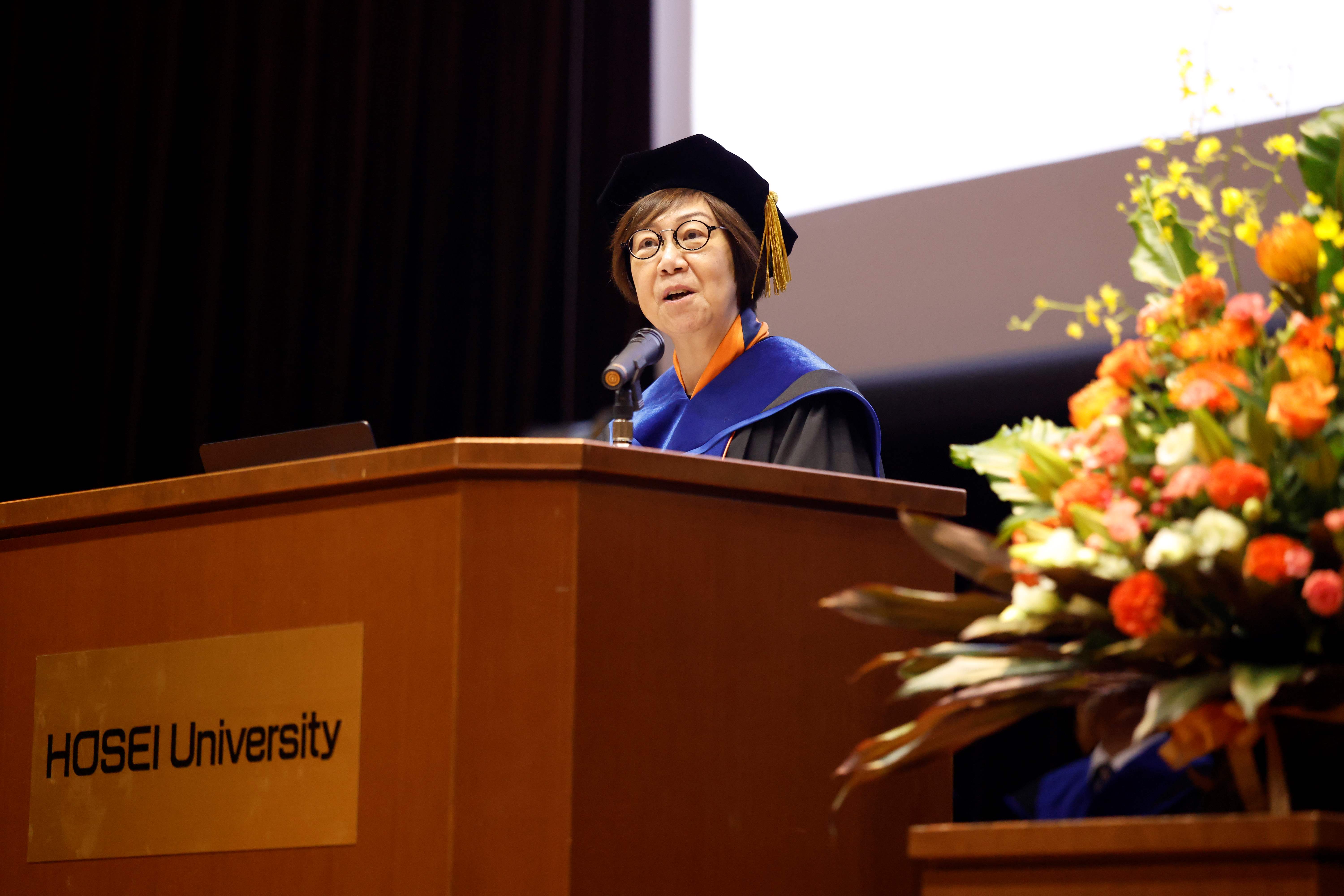
法政大学は今年、創立146年を迎えました。この長い年月の中で、社会も世界も大きく変わり、法政大学もまた変わり続けてきました。しかし、ただ時代の流れに合わせて変わってきたわけではありません。
「自由と進歩」という建学の精神、そしてそれを今の時代に引き継ぐ大学憲章の「自由を生き抜く実践知」。そうした原点に立ち返りながら、その時代、その社会に必要な大学へと、自らを変えてきました。
少し違う例として、お茶の話をしたいと思います。
お茶の世界では、茶碗をはじめとする茶道具がとても大切です。その一つに、樂茶碗があります。
樂茶碗の歴史は、今からおよそ450年前に始まりました。それ以来、樂家は現在の十六代まで続いています。伝統を大切にしながら、それぞれの代が、その時代ならではの自分自身の樂茶碗をつくってきました。
また、「写し」というものがあります。しかし、それも単に昔の茶碗をそっくりそのまま複製することではありません。先代の作品を受け止め直し、そこから自分なりの新しい表現を生み出していくものです。
私は、この、伝統を受け継ぎながら、絶えず新しいものを生み出していくというあり方は、法政大学が歩んできた道にもよく似ていると思います。
伝統を受け継ぐ。しかし、その伝統を生きたものにするために、絶えず進化し、自らをつくり変えていく。
これから皆さんは、それぞれ次のステージへ進みます。
皆さんがどこへ行き、何をすることになっても、自分の周りの何かを変える力があります。社会や世界の問題は、時にあまりにも大きく、自分一人には何もできないと思うことがあるかもしれません。しかし、どんなに大きな問題にも、自分にできることは必ずあります。
大切なのは、流されるのではなく、自分の土台に立ち返り、自分が何を大切にするのかを確かめ、自分はどのような変化を起こしたいのかを考え、行動することです。
法政大学は、世界のどこにいても自分らしく生き抜くだけでなく、自ら考え、自ら行動し、より多くの人にとって生きやすい社会をつくることのできる人を育むことを大切にしてきました。
皆さんは、そうした法政のDNAを受け継いでいます。このことは、ぜひ覚えておいてほしいと思います。
そして、それに加えて、これから皆さんに意識してほしいことを、3つお伝えしたいと思います。
まず、学び続けてください。
最近、「リスキリング」という言葉をよく耳にします。でも私は、この言葉に少し違和感があります。もちろん、新しいスキルを身につけること、今持っているスキルをアップデートすることは大切です。
でも、学びというのは、一度やめて、必要になったらまた始めるものではないと思います。学びは、静かに続けていくものです。
何かを経験することで学ぶこともあります。教室で学ぶこともあります。本を読むこと、人と話すこと、失敗することから学ぶこともあります。
学び続けることで、私たちは、新しい状況に出会っても、自分の土台を失うことなく、自分自身を更新し続けることができるのだと思います。
第二に、どんな仕事に就いても、責任をもって取り組んでください。
今日ここにいる皆さんの中には、第一志望だった仕事に就き、これから始まる仕事をとても楽しみにしている人もいるでしょう。一方で、必ずしも最初に思い描いていた道に進むわけではない人もいると思います。
それでも、自分がする仕事には責任をもって向き合ってほしいと思います。
私はスタンフォード大学で社会学の博士号を取得した後、海外研究員として法政大学で研究を続けました。しかし、最初に就いたフルタイムの仕事は、実は英語を教える仕事でした。本当は社会学を教えたいと思っていました。自分が思い描いていた仕事ではありませんでしたが、やるからにはできる限りのことをしようと思いました。多くの教科書を参考にしながら、自分で教材をつくり、学生に無料で配りました。
それは、もう20年ほど前のことです。最近、そのときの学生数人に、20年ぶりに会う機会がありました。そのうちの一人は、息子さんを連れてきてくれました。そして、息子さんの英語力を伸ばすために、今でも私がつくった教材を使っている、と話してくれました。
それを聞いたとき、どれだけ嬉しかったか、皆さんにも想像していただけると思います。
自分がしていることが、いつ、どこで、誰に、どのような影響を与えるかは分かりません。その場では何も起きていないように見えても、ずっと後になって何かにつながることもあります。
だからこそ、目の前の仕事に敬意をもち、責任をもって取り組んでほしいと思います。
第三に、自分の考えを持ちながら、決めつけないことです。
私たちには、それぞれ大切にしているものがあり、どうしても譲れないこともあります。それは大切です。先ほどお話しした、自分の土台や軸にもつながるものです。
同時に、法政大学の中でもさまざまな考え方に触れてきたと思いますが、大学を出ればなおさら、自分とはまったく違う考え方をする人に出会います。
コミュニケーションとは、自分の意見を伝えることだけではありません。相手の話を聞くことでもあり、同時に、自分自身の考えや価値観を振り返ることでもあります。
自分が何を大切にしているのかを意識しながら、心を開いて人の話を聞く。事実や根拠については冷静に考え、人に対しては思いやりを持つ。
学び続けること。目の前の仕事に責任をもつこと。そして、自分の軸を持ちながらも、異なる考えに心を開くこと。
この3つは、別々のようでいて、実はすべてつながっています。自分の土台を大切にしながら、自分自身を問い直し、学び、変わり続けていく。その姿勢があれば、皆さんはこれからどのような変化に直面しても、ただ流されるのではなく、自分の道を自分でつくっていくことができると思います。
今日は、GISをはじめ、英語で学ぶさまざまなプログラムから卒業する皆さんもいます。ここから少し、英語でお話ししたいと思います。
Among those of you graduating today are students from GIS and our various English-taught programs. I trust that most of you have understood most, if not all, of what I have just said in Japanese. But let me repeat the key points in English.
The years you have spent at Hosei may be only a small part of your life, but I hope that during those years you have built a foundation of your own—a sense of what matters to you, what you stand for, and what you will not easily give up.
A strong foundation does not mean resisting change. It allows you to change deliberately, rather than simply drift. Hosei itself has done this for 146 years: evolving while remaining rooted in its founding spirit of freedom and progress.
Do not be afraid to change, but do not drift. Indeed, be the change you want to see in the world. The problems around us may seem enormous, but there is almost always some part of them on which we can act. Return from time to time to the foundation you have built here, and move forward from it.
There are three other things I hope you will keep in mind as you leave Hosei.
First, continue to learn. Learning does not stop and restart when we suddenly need a new skill. It continues throughout our lives—through study, experience, other people, and sometimes our mistakes.
Second, whatever work you do, approach it with responsibility. You never know what impact something you do today may have on someone, perhaps many years from now.
Third, have views of your own, but do not assume that you already know. Listen to people who see things differently. Look at evidence with a cool head, and relate to people with compassion.
Congratulations again on your graduation. I hope you will carry something of Hosei with you wherever you go, while continuing to learn, to change, and to build a life that is truly your own.
改めて、ご卒業おめでとうございます。
これから皆さんが、それぞれの場所で、どのような道を切り開いていくのか、楽しみにしています。
Congratulations to all of you on your graduation.
Today marks an important milestone for each of you. It is a day to celebrate all the effort that has brought you here, and to cheer you on as you take your next steps.
I believe that the years you have spent at Hosei have been an important time for thinking about what matters to you and how you want to live your life.
Your studies and research, the activities you took part in, the friends and colleagues you met, the discussions you had with your professors—through each of these experiences, you have gradually built a foundation of your own.
The world around you, and the circumstances in which you live and work, will continue to change. But if you have a strong foundation, you do not need to fear change. Rather than simply being carried along by it, you can keep sight of what matters to you and choose for yourself how you want to change.
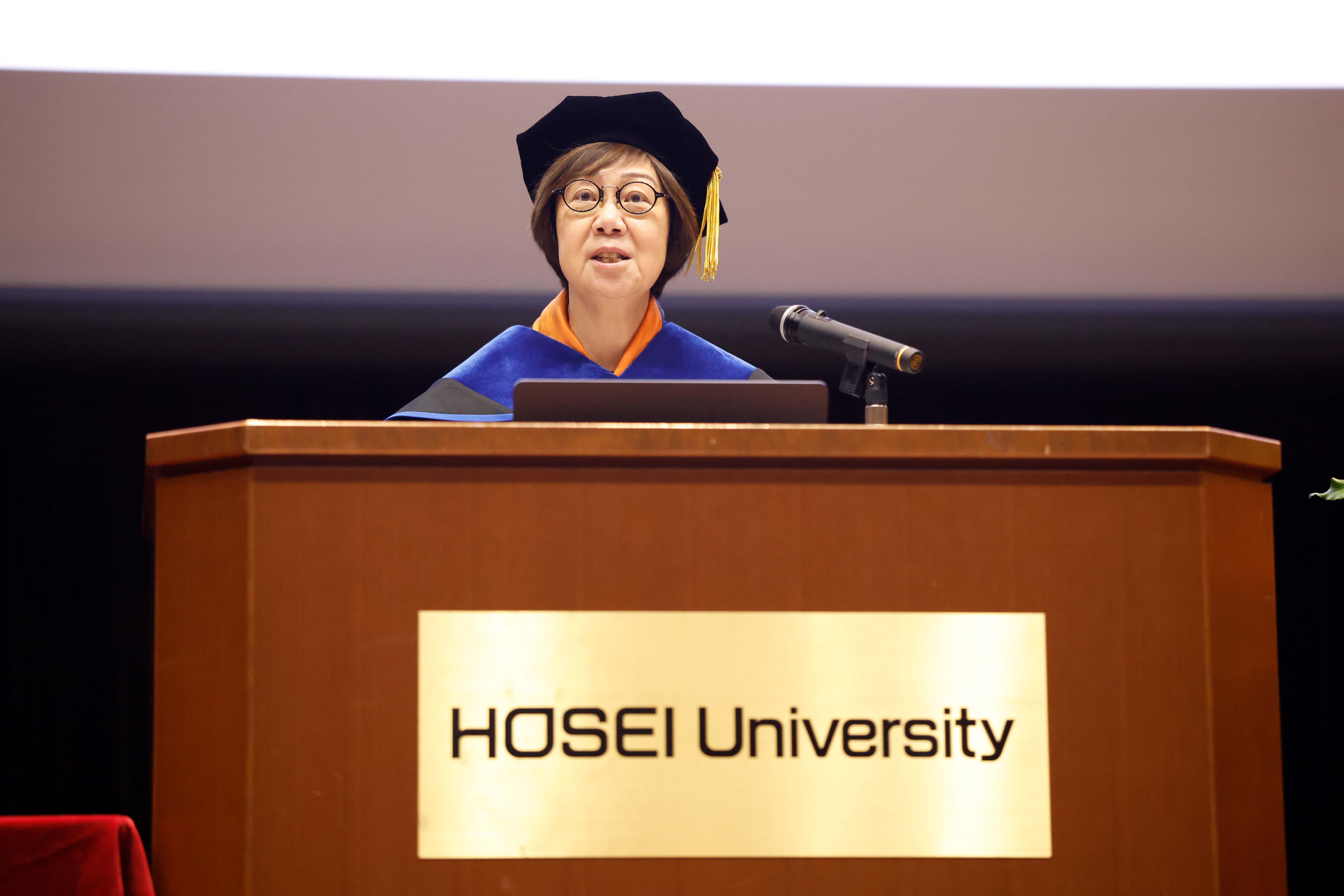
This year marks the 146th anniversary of Hosei University’s founding. Over those many years, society and the world have changed enormously, and Hosei too has continued to change.
But it has not simply changed in order to follow the times.
Hosei has continued to return to its founding spirit of “Freedom and Progress,” and to the idea expressed in our University Charter as “Practical Wisdom for Freedom,” while transforming itself into the kind of university needed in each new era and society.
Let me give you a somewhat different example, from the world of tea.
In the world of Japanese tea, utensils are extremely important, and among them, of course, are tea bowls. One particular tradition is that of Raku tea bowls.
The history of Raku tea bowls began some 450 years ago. Since then, the Raku family has continued through sixteen generations. While honoring that tradition, each generation has created its own Raku bowls, distinctive both to its time and to the individual who made them.
There is also something known as a “copy,” or utsushi. But this does not mean reproducing an old tea bowl exactly as it was. It means engaging afresh with the work of an earlier generation and, from that, creating a new expression of one’s own.
I think this way of preserving tradition while continually creating something new is very similar to the path Hosei itself has followed.
We inherit tradition. But in order to keep that tradition alive, we must continue to evolve and remake ourselves.
From here, each of you will move on to the next stage of your life.
Wherever you go and whatever you do, you have the power to change something around you. The problems facing society and the world can sometimes seem so large that you may feel there is nothing one person can do. But however great the problem, there is always some part of it on which you can act.
What matters is not simply allowing yourself to be carried along by events, but returning to your own foundation, asking yourself what truly matters to you, thinking about what kind of change you want to bring about, and then acting.
Hosei has always placed great importance on nurturing people who can not only live as themselves wherever they may be in the world, but who can also think for themselves, act for themselves, and help create a society in which more people can live well.
You have already inherited that Hosei DNA. I hope you will always remember that.
And beyond that, there are three things I would especially like you to keep in mind as you move forward.
First, keep learning.
Recently, we often hear the word “reskilling.” I have to admit that I feel slightly uneasy about the term. Of course, learning new skills and updating the skills we already have are important.
But I do not think learning is something we stop, only to start again when we suddenly need it.
Learning continues quietly throughout our lives.
We learn through experience. We learn in classrooms. We learn from books, from conversations with other people, and from our mistakes.
By continuing to learn, we can keep renewing ourselves as we encounter new situations, without losing the foundation on which we stand.
Second, whatever work you do, approach it with a sense of responsibility.
Some of you here today may be about to begin the job you had hoped for most, and may be very excited about what lies ahead. Others may find yourselves taking a path different from the one you originally imagined.
Even so, I hope you will approach whatever work you do with a sense of responsibility.
After completing my PhD in sociology at Stanford University, I continued my research at Hosei as an overseas research fellow. But my first full-time job was actually teaching English. What I really wanted to teach was sociology. It was not the job I had imagined for myself, but I felt that if I was going to do it, I should do it as well as I possibly could. I consulted many different textbooks, created my own teaching materials, and gave them to my students free of charge.
That was about twenty years ago.
Recently, I had the opportunity to meet several of those former students again for the first time in twenty years. One of them brought her son with her. She told me that she was still using the materials I had created to help her son improve his English.
I think you can imagine how happy that made me.
We never know when, where, or how something we do may affect another person. At the time, it may seem that nothing has happened at all, and yet many years later, it may lead to something we could never have expected.
That is why I hope you will respect the work in front of you and approach it responsibly.
Third, have views of your own, but do not make assumptions too quickly.
Each of us has values that matter deeply to us, and principles on which we are not easily willing to compromise. That is important. It is part of the foundation and the inner compass I spoke about earlier.
At the same time, you have already encountered many different ways of thinking here at Hosei, and once you leave the university, you will meet even more people whose views are completely different from your own.
Communication is not simply about expressing your own opinion. It also means listening to others, and at the same time reflecting on your own ideas and values.
Know what matters to you, but listen to others with an open mind. Think calmly about facts and evidence, and treat people with compassion.
Continue to learn. Take responsibility for the work in front of you. And while keeping your own inner compass, remain open to ideas different from your own.
These three things may sound separate, but in fact they are closely connected. If you can remain grounded in your own foundation while continuing to question yourself, learn, and change, then whatever changes you encounter in the years ahead, you will be able not simply to drift, but to shape your own path.
Among those graduating today are students from GIS and from a range of English-taught programs. So I would now like to say a few words in English.
(The original English is translated into Japanese)
今日卒業する皆さんの中には、GISや、英語で学ぶさまざまなプログラムの学生もいます。今まで日本語でお話ししたことのほとんど、あるいはすべてを理解してくださったと思いますが、ここで大切なポイントを英語でも繰り返したいと思います。
法政大学で過ごした数年間は、皆さんの人生の中ではほんの一部かもしれません。しかし、その間に、自分にとって何が大切なのか、自分は何を大事にして生きていくのか、そして簡単には譲れないものは何なのか。そうした、自分自身の土台を築いてきたことを願っています。
しっかりした土台を持つということは、変化に抵抗するということではありません。むしろ、ただ流されるのではなく、自分の意思で変わっていくことを可能にしてくれるものです。法政大学も、この146年間、「自由と進歩」という建学の精神に根ざしながら、絶えず進化してきました。
変わることを恐れないでください。しかし、流されないでください。そして、自分が望む変化を、自ら起こしてください。私たちを取り巻く問題は、とても大きく見えることがあります。しかし、ほとんどの場合、その中には必ず、自分にできることがあります。時々、ここで築いた自分自身の土台に立ち返り、そこからまた前へ進んでください。
そして、法政を巣立つ皆さんに、もう三つ、覚えておいてほしいことがあります。
まず、学び続けてください。学びは、新しいスキルが必要になったときに一度止めていたものを再び始める、というものではありません。学びは、生涯を通じて続いていくものです。勉強を通して、経験を通して、人との出会いを通して、そして時には失敗を通して、私たちは学び続けます。
第二に、どんな仕事をすることになっても、責任をもって取り組んでください。今日したことが、何年も後になって誰かにどのような影響を与えるかは、分からないものです。
第三に、自分の考えを持ってください。しかし、自分はもう分かっている、と決めつけないでください。自分とは違う見方をする人の話にも耳を傾けてください。事実や根拠については冷静に考え、人に対しては敬意を持って向き合ってください。
改めて、ご卒業おめでとうございます。これからどこへ行っても、法政で培ったものを大切にしながら、学び続け、変わり続け、そして自分らしい人生を築いていってほしいと思います。
Once again, congratulations on your graduation.
I look forward to seeing the paths each of you will create for yourselves, wherever you may go.
