

開催日時:2026年6月13日(土)14時30分~16時30分
会場:法政大学市ヶ谷キャンパス 大内山校舎6階 Y605
主催:法政大学国際日本学研究所
共催:法政大学江戸東京研究センター
開催方式:対面+オンライン(Zoom)
報告者:グローマー・ジェラルド(山梨大学名誉教授・法政大学国際日本学研究所客員所員)
コメンテーター:田中優子(法政大学名誉教授・国際日本学研究所客員所員)
司会:横山泰子(法政大学理工学部教授・国際日本学研究所長)
“The Music of Tenka Matsuri”
The term tenka matsuri, literally “festivals of the realm,” was popularly applied to the Sannō Festival (of what is today the Hie Shrine), the Kanda Festival (of today’s Kanda Shrine), and the 1714 Nezu Festival (of the current Nezu Shrine). These three great festivals of Edo were authorized and partially funded by the Tokugawa bakufu. The parades entered Edo Castle grounds and were often viewed by the shogun, his family, and top regime officials.
In addition to the usual portable shrines (mikoshi), the processions included a large number of secular floats, displays, dancing, and music. A look at folding screens depicting the Sannō Festival a year before the disastrous fire of 1657 indicates, however, that tenka matsuri music of this era was still quite limited. Clearly not all participants were depicted in these screens, but the floats and mikoshi appear to have been accompanied only by ōdaiko (large barrel drums) and daibyōshi (large, laced hourglass drums). In addition, a cart carrying a kagura group may have included flutes and large and small hourglass drums.
By 1677, the volume Edo suzume relates that the Sannō Festival parade, possibly in its “supplemental exhibits” (tsukematsuri), featured “short songs, shamisen, flutes, small hourglass drums (tsuzumi), barrel drums (taiko), and hand gongs.” In addition to the standard flute-and-percussion (hayashi) ensemble, from the late seventeenth century the shamisen also began to be incorporated into tenka matsuri processions. As the preface of the 1687 Edo Kanoko records, kiyari, a type of song usually rendered by carpenter/firemen, also found its place in the Sannō Festival. A picture scroll and written records of the 1707 Sannō Festival indicates that by this time the variety of musical genres and the number of performers had once again increased. “Field music” (dengaku, often including shishi-mai “lion dances”) was accompanied by a string of clappers known as binzasara and large “hip drums” (koshi-daiko) strapped to the waist of the performers. By the Edo period dengaku and kagura genres must have served to indicate the festival’s authority and ancient origins, for as Ōta Nanpo recounts in 1806, “I too saw this item called dengaku for the first time today and it seemed so very old-fashioned.” The number of musicians increased as well, and by 1707 wards such as Nihonbashi-Honchō, Odawara-chō, and Shin-Kokuchō were sending a total of more than two dozen “hayashi performers” (hayashi yakusha) to participate in the procession.
The hayashi heard in Edo festivals is said to derive from styles developed in Kasai, east of the city. This so-called Kasai-bayashi, also dubbed“fool’s music”(baka-bayashi) or “youth music” (waka-bayashi), appears to have been the source of Kanda-bayashi, a common form of festival hayashi heard today. This argument, today the established view, was presented in 1898 in the journal Fūzoku Gahō by a man perhaps named Kyōson Sei (or Shō), a reporter for the Chōya Shinbun. Even though Kyōson’s essay is riddled with obvious errors, it remains an interesting account of late nineteenth century oral transmissions of Kasai-based festival musicians. During the nineteenth century, festival music flourished in the Honjo and Katsushika areas east of Edo. Saitō Gesshin’s Buke nenpyō (published 1850) confirms this, stating that, “Around the ninth month, as night falls, the sound of drumming from somewhere yonder can be heard.” To this, Kitamura Nobuyo (1783-1856) adds, “The sounds of nighttime drums are the so-called Honjo ghost drums (bake-daiko). When all is quiet at night, even distant sounds seem to carry farther. The sounds drift in the wind, so they are vague and indistinct, and people find it eerie. In places like Honjo Koume-[chō] and Terajima-[chō], young men learn to play “fool’s rhythms” (baka-byōshi). They often gather at night to perform. The [music of the] floats of the Kanda and Sannō festivals is largely based on this style. Because it originates in Kasai, it is generally called ‘the Kasai.’” The first documented reference to a Kanda-bayashi piece appears in the 1793 “Kanda Myōjin Festival Picture Scroll” of the Ryūgasaki Museum (a second copy with glosses is in the collection of the Tokyo National Museum).
One of the most popular Edo festival musical genres was “foreign music” (tōjin-bayashi). Foreignness is already indicated by the Korean-style hats worn by the drummers on the first float, presented by Ōdenma-chō, but it was the display of the huge cloth elephant by Kōjimachi that most famously featured tōjin-bayashi. The instruments used in this exhibit were again probably Korean: the taepyongso (double-reed flute), nabal (trumpet), sogum (small bamboo flute), sogo (small drum), jing (gong), and yongo (barrel drum). The taepyeongso and nabal were in fact already used by the band accompanying the equestrian troupe arriving with the Korean diplomatic mission of 1719. Later the same instruments reappeared in many Kanda Festival exhibits.
From the last decades of the eighteenth century, numerous jōruri and nagauta compositions added further musical interest to tenka matsuri exhibits. Most of the pieces heard were created specifically for the occasion, and local community leaders, such as the ward head and literati Saitō Gesshin number among the lyricists. Performers were typically male geisha whose identities can be confirmed in guides to Yoshiwara, or jōruri reciters and nagauta shamisen players employed by the kabuki theaters. Female musicians, often classified as “amateurs,” also ranked as top-tier Edo festival performers. By the nineteenth century, the music of tenka matsuri had evolved from simple drumming and fifing to a version in miniature of nearly the entirety of the Edo musical world.
(報告者:グローマー・ジェラルド(山梨大学名誉教授・法政大学国際日本学研究所客員所員)
-
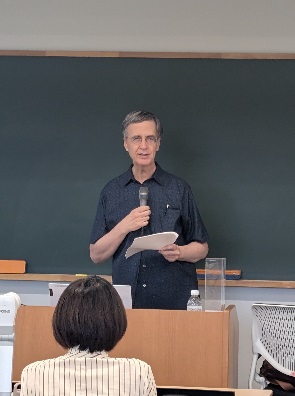
報告者:グローマー・ジェラルド氏
-
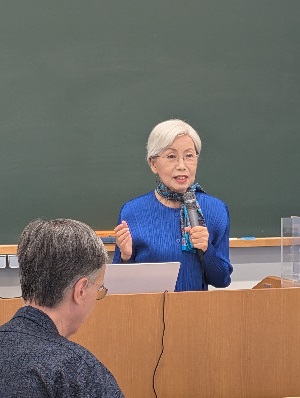
コメンテーター:田中優子氏